Right-Hand Drive Gap: Tesla Halts Cybertruck Plans for Australasia
After nearly seven years, Tesla has refunded deposits and ended Cybertruck reservations in Australia and New Zealand due to the high cost of adapting the vehicle for right-hand drive markets.
By Malik Salazar ·
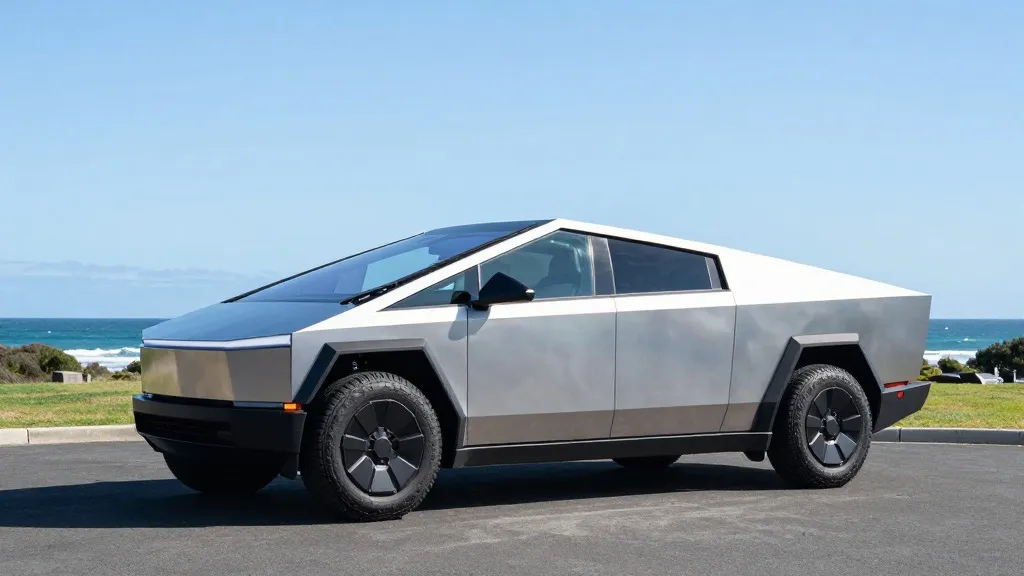
For almost seven years, drivers in Australia and New Zealand have held onto a promise that never quite materialized. Today, Tesla officially severed that tie, emailing reservation holders to inform them that the Cybertruck will no longer be produced for their markets. The decision ends a long period of uncertainty, returning the roughly A$150 deposits paid by early adopters and confirming that the electric pickup is not coming to the region in its current form.
The primary obstacle is mechanical rather than financial. The Cybertruck is exclusively designed with a steering wheel on the left, a configuration incompatible with the right-hand drive requirements of Australia, New Zealand, and several other major markets. Adapting the vehicle’s complex architecture to move the driver to the right side would require significant re-engineering and certification. Given the vehicle’s current sales trajectory, Tesla determined that the investment was no longer justified by the potential volume of units sold in these two countries, which together serve a population of approximately 33 million.
This cancellation follows a pattern of delayed expectations. Tesla began accepting reservations in Australia in late 2019, a period when the vehicle was projected to be more affordable and higher in range. By 2022, the company quietly closed the reservation page, leaving existing customers to wait without refunds. Although CEO Elon Musk suggested in 2024 that certification for other markets might occur "next year," the truck never received the necessary right-hand drive modifications. The email sent today marks the first formal conclusion to that wait.
The timing of the announcement is significant, arriving just one day after Tesla released its third-quarter 2026 earnings. The data highlights the challenge facing the Cybertruck program: the vehicle is now a niche product. In the most recent quarter, Tesla delivered roughly 7,000 to 8,000 Cybertrucks, a figure that represents a fraction of the 250,000 units per year the production line was originally designed to handle. This slower pace makes the cost of developing a new version for the Southern Hemisphere difficult to sustain.
To soften the blow, Tesla is offering a strategic pivot for those who remain interested in the brand. While the Cybertruck reservation is void, customers who order a new Model 3 or Model Y will receive a free one-year subscription to Full Self-Driving (Supervised). This approach allows Tesla to convert lapsed pickup truck interest into sales of vehicles it already manufactures in right-hand drive configurations. Refunds for the cancelled Cybertruck orders are expected to be processed within 30 days.
The move reinforces the reality that the Cybertruck is now primarily a North American product. International deliveries have been limited to left-hand drive markets such as South Korea and the UAE, while the truck remains blocked in the European Union due to safety regulations. With production volumes stabilizing at a much lower level than initial projections, Tesla appears to be focusing on optimizing its existing global footprint rather than expanding the Cybertruck into more expensive, right-hand drive territories.