Harvard researchers find Moon water limits sustainable cities to 10,000
A new study suggests lunar water reserves support small settlements for centuries, but large populations would deplete the supply within a century.
By Sarah Montgomery ·
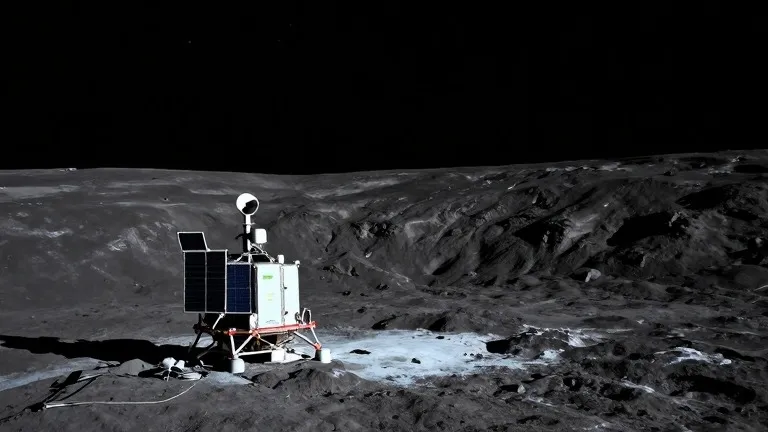
Residents of future lunar bases face a hard limit on population size due to scarce water reserves, according to a new analysis. The study indicates that while large cities are theoretically possible, the moon's available water cannot sustain them for long periods without external replenishment.
The research, published in Frontiers in Space Technologies, estimates that the moon holds approximately one billion tonnes of water. This resource is concentrated in permanently shadowed regions at the poles. Under these assumptions, a population of one million people could survive for only about 100 years. This timeline assumes a 98% water recycling rate, matching the efficiency currently achieved on the International Space Station.
Martin Elvis, a senior astrophysicist at Harvard University's Smithsonian Astrophysical Observatory, co-authored the paper with Jonathan McDowell, an honorary professor at the Durham University Space Research Centre. They tested claims made by space industry leaders against physical constraints. In February, Elon Musk stated that SpaceX aims to build a self-growing city on the moon in under 10 years. Jeff Bezos has previously predicted that millions of people will live in space by 2045.
The authors found that power generation is less of a bottleneck than water supply. Solar and nuclear energy sources should be sufficient to support one million people. The limitation lies in the volume of accessible water. Elvis compared the total water supply to an aquarium the size of Central Park filled until the Statue of Liberty is just underwater. He described it as a small lake that cannot supply a big city for very long.
A settlement of 10,000 residents would be sustainable for centuries under the same assumptions. McDowell noted that covering the moon with cities, as depicted in science fiction, would require finding a way to transport water to the surface because it is not currently available in sufficient quantities for that scale. Elvis suggested that the initial estimate of one billion tonnes might be 20 to 30 times too large. He estimated that only one percent of that figure is realistically recoverable, which would reduce the 100-year lifespan for a million-person city to roughly one year.
Gordon Osinski, a professor of planetary geology at Western University in London, Ont., noted that satellite measurements of lunar water carry uncertainties. He believes the water exists but requires on-ground confirmation. Osinski suggested the water may resemble Arctic permafrost, with sub-millimetre ice crystals mixed into soil that are difficult to extract. McDowell stated that the findings should not discourage exploration, adding that the truth is never negative and that attempting projects known to be unfeasible is the real error.