Carrion Crows Reach Visual Decisions in Half the Time of Primates
A new study from the University of Tübingen demonstrates that birds use the same evidence accumulation logic as monkeys to solve motion puzzles, but at double the speed.
By Malik Salazar ·
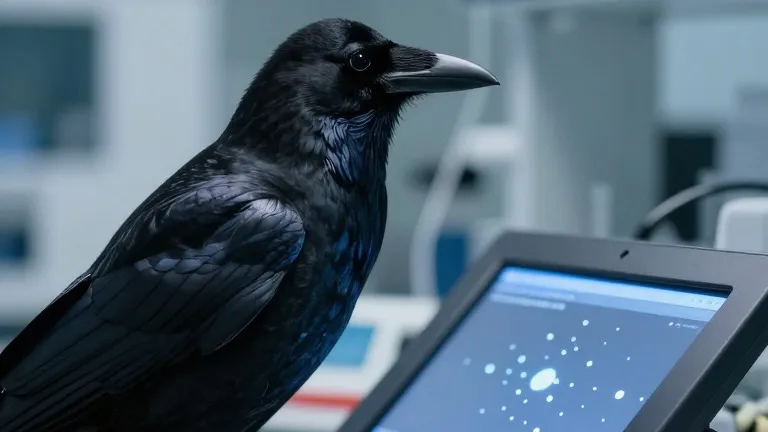
Carrion crows solve complex visual motion tasks using the same cognitive logic as primates, but they arrive at their decisions in half the time.
The study, published this week, tests how brains without a neocortex process ambiguous visual information. Previous research established that primate neurons in the neocortex collect evidence over time. These firing rates rise until they cross a threshold, triggering a final choice. Because birds lack this specific brain structure, scientists had no prior model for how their neural networks handle similar computations.
Andreas Nieder, a neurobiologist at the University of Tübingen, led the effort to determine how an avian brain encodes these decisions. He and colleague Philipp Schmidbauer placed two hand-raised carrion crows in front of a touch-sensitive monitor. The screen displayed a cloud of flickering white dots on a black background. A specific fraction of these dots drifted together in one of four directions: left, right, up, or down. The crows indicated the direction of movement by pecking a target next to the display, earning a mealworm for each correct response.
The researchers designed the experiment to be identical to the standard random-dot-motion task used with monkeys. The only physical difference was the method of response; monkeys used eye movements to signal their choice, while the crows used pecks. The difficulty of the task was controlled by adjusting the percentage of dots that moved coherently. At the easiest level, 81 percent of the dots moved in unison. At the hardest level, only 3 percent moved together, making the signal nearly indistinguishable from random noise. The team also included a condition with 0 percent coherence, where no correct answer existed.
The crows successfully solved the task using the same mathematical logic observed in primates. Despite the fundamental differences in brain organization between the two groups, the birds accumulated visual evidence in a manner comparable to the monkey neocortex. The critical distinction was speed. The crows reached the decision threshold twice as fast as the primates in the reference data. This finding confirms that a brain without a neocortex can execute complex, evidence-based decisions with high efficiency.