New label reclassifies 324-million-year-old San Diego fossil as insect
A re-examination of a specimen in museum storage has shifted it from crustacean to insect, filling a gap in the fossil record.
By Harper Laurent ·
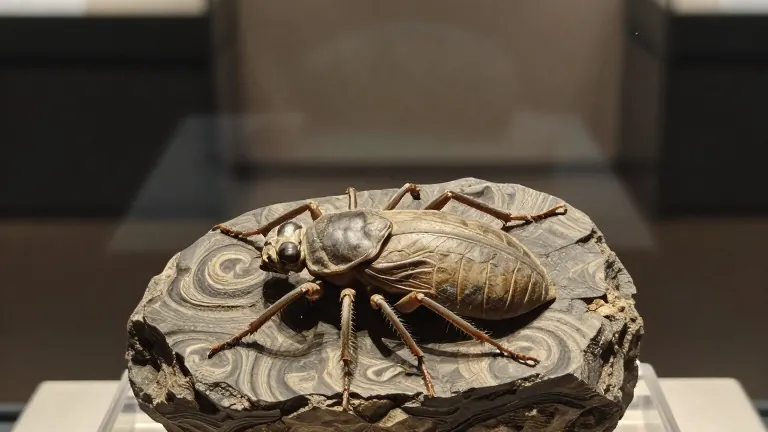
A specimen at the San Diego Natural History Museum is now classified as an insect, a change that rewrites its place in the history of life. The fossil, cataloged as number 28852, had been stored in a basement vault for decades under the name Tesnusocaris goldichi. It was identified as a crustacean until a new label was affixed following a review by a researcher from Cambridge University.
The reclassification identifies the creature as Chosha praecursor. This shift moves the specimen from the group of aquatic crustaceans to the hexapods, which include insects. Erik Thelka, a doctoral student at Cambridge University, examined the fossil after seeing images in a textbook. He traveled to San Diego to inspect the specimen under polarized light. Thelka found features he associated with insects, including an ovipositor for egg-laying and a terminal filament resembling a tail.
The specimen displays six legs attached to its thorax, a defining trait of insects. However, it also possesses numerous additional pairs of paddle-like legs on its abdominal segments. These extra limbs are typically found in crustaceans. The research team suggests these limbs allowed the animal to swim. They propose that the creature moved between land and water, resembling a large silverfish in its lifestyle.
The age of the fossil places it at 324 million years. This date sits near the younger boundary of the hexapod gap, a period of 60 million years with little evidence of insect life. By reclassifying this specimen, researchers have also re-evaluated other fossils. They concluded that those specimens are also insects. Together, these findings represent the earliest uncontested insects in the fossil record.
The fossil originated in Brewster County, Texas, where it was unearthed in 1985. Frederick Schram, then a curator at the museum, led the field team. Schram, a crustacean researcher who has written textbooks on the subject, published a paper in 1991 describing the find. He did not respond to an email request for comment regarding the new classification. The specimen was loaned to researchers in Eastern Europe and Germany for further examination during that period.
Tom Deméré, the museum’s curator of paleontology, was a curatorial assistant when Schram brought the fossil to San Diego. Deméré noted that the collection holds specimens gathered over the last 100 to 150 years. He stated that the reclassification demonstrates that new discoveries can emerge from existing archives. The museum has since installed the fossil in a glass enclosure on its lower level.
The new exhibit allows visitors to view the swirled patterns of the specimen. Supporting references note the recent attention the fossil has received in scientific journals and national media. Deméré emphasized that such collections allow paleontologists to study the full history of life on Earth, including extinct lineages and their adaptations.