France records 980 arrests after protests turn violent
Police deployed heavy forces to prevent a repeat of last week's chaos, but clashes broke out in Paris and Marseille as crowds dispersed.
By Harper Laurent ·
French authorities detained 980 people on Saturday after evening protests turned violent in several major cities. Interior Minister Laurent Nuñez confirmed the count late in the day, noting that the number would likely increase. Two protesters suffered serious injuries during the unrest, one in Toulouse and the other in Clermont-Ferrand.
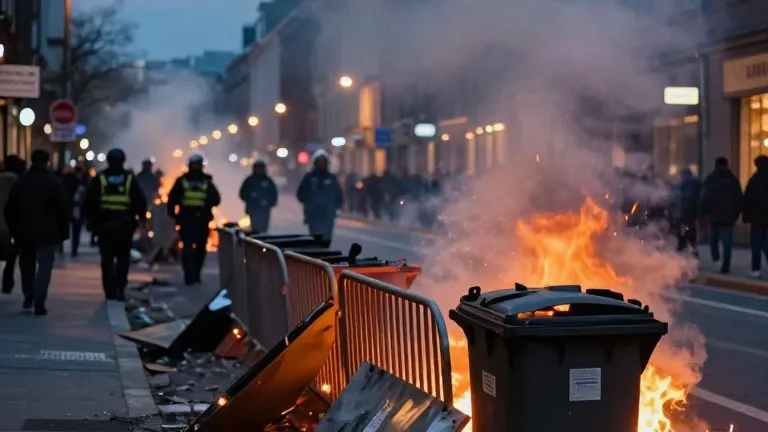
The violence followed a largely peaceful daytime march. In Paris, trouble erupted at the end of a route from Porte d'Italie to Porte de Vincennes. Protesters built barricades and threw objects at police. Officers charged with batons at groups of masked youths who smashed the windows of a car dealership. An elite unit usually assigned to counter-terrorism was part of the police response.
In Marseille, demonstrators set rubbish bins on fire and used metal sheets to block streets. In Bordeaux, people tore boards off a shop. Police in Lyon fired tear gas to disperse a crowd of approximately 150 students in an area declared off-limits by the local prefecture.
Officials estimated the turnout at 410,000, while unions claimed around 800,000 attendees. The government deployed about 70,000 police officers to maintain order. This heavy presence was a direct response to the previous weekend, when 550,000 people protested and over 2,500 arrests were made. Last week's disorder saw more than 2,000 businesses damaged, with losses estimated in the hundreds of millions of euros.
President Emmanuel Macron restricted demonstrations to those organized by recognized trade unions earlier in the week. Fast-track courts have since jailed hundreds of people for vandalism and looting. The goal of this week's police strategy was to avoid the widespread rioting that characterized the previous weekend.
Protesters expressed frustration over living costs and school conditions. Zelie, a 26-year-old protester in Paris, told the BBC that people are suffering and that the situation has become too much. Two masked teenagers said their generation feels abandoned by the government. One teen admitted looting was not good but blamed poverty and police violence for the behavior.
Unrest also occurred in other European cities. Riot police in Tirana, Albania, fired tear gas at anti-government demonstrators. Clashes were reported in Brussels. In Milan, hundreds of soldiers and police blocked protesters from gathering to prevent a repeat of recent violence.
The next phase of the political cycle begins in six months with presidential elections. Leading candidates have already begun blaming President Macron and his ministers for the unrest. The government continues to process the aftermath of this week's protests while monitoring the lead-up to the vote.