Election Strategy: Palestinians Vote to Prevent Displacement
Historically low confidence in the state is driving a surge in voter turnout among Israel's Arab citizens, who fear the far-right government's agenda.
By Harper Laurent ·
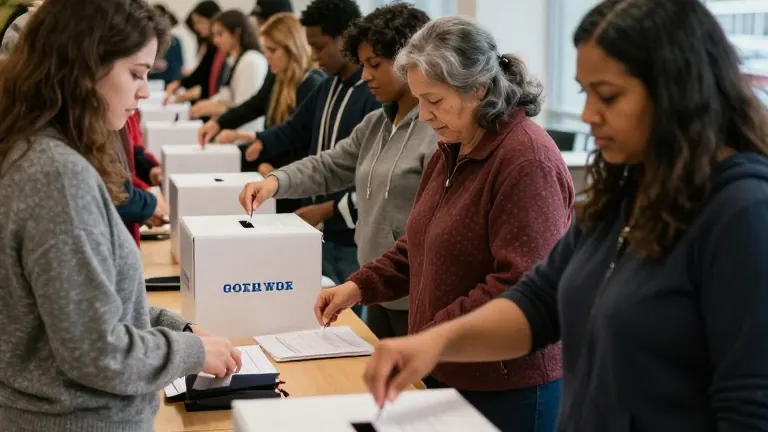
Ibrahim Said, a 70-year-old Palestinian citizen of Israel, has boycotted every national election since 1980. For decades, he viewed the polls as a ritual that offered no tangible improvement for his community. That calculation has changed. Standing in his garage in the Galilee, Said says the current political climate demands participation. He describes a situation where survival, rather than standard political engagement, is the primary motivation for voting.
Election day is scheduled for Tuesday, marking the first general vote since 2022. The current government, led by Benjamin Netanyahu, holds power alongside allies Bezalel Smotrich and Itamar Ben Gvir. Their coalition has advanced a legislative agenda that includes the potential deportation of Palestinian citizens. Smotrich’s Religious Zionism party has promised to "Judaise" the Galilee and Negev regions, where hundreds of thousands of Palestinians reside. For many in the community, this rhetoric has transformed the election from a routine civic duty into a defensive act.
Ameer Fakhoury, an analyst at the Vanleer Institute, notes that minority participation usually signals confidence in a democratic system. In Israel, the trend is reversed. Fakhoury argues that high turnout indicates a lack of trust in state institutions and a desire to cling to political forces that might offer protection. He estimates turnout could reach 72 percent or 73 percent, up from 54 percent in the 2022 election. This increase would likely allow the Joint List and Raam to secure approximately 15 seats in the 120-member Knesset, matching the high achieved in 2020.
The shift in strategy is driven by a perception that the state itself poses an existential threat. Fakhoury states that Palestinians are voting to prevent displacement and protect the basic conditions of their existence. He emphasizes that the goal is not merely to repeal the 2018 Nation-State Law or secure budgets, but to avoid a fate similar to that of Gaza and the West Bank. The objective is to prevent ethnic cleansing from within the state of which they are citizens.
Jowan Safadi, a musician who has traditionally boycotted elections, is reconsidering his position. He argues that the state is not democratic, given that only the 2.1 million Palestinian citizens within Israel's borders can vote, despite nearly equal Jewish and Palestinian populations under Israeli control. However, Safadi acknowledges that the current government's extremism leaves few options. He describes the choice as moving from a terrible situation to one that is marginally less terrible. He credits the far-right ministers, particularly Ben Gvir and Smotrich, for effectively doing the campaigning for the Arab lists by highlighting the stakes.
The far-right rhetoric has also reduced the financial resources needed by Arab parties to campaign. A source in the Joint List indicates that parties are spending less money than in previous years because voters are motivated by the terrifying language of the government. The Joint List and Raam are competing to represent the community, with Raam, led by Mansour Abbas, positioning itself as a socially conservative option that delivers concrete benefits through alliances with Zionist parties.
Security concerns are a central factor in the decision to vote. Adham, a mechanic in northern Israel, cites organized crime and the high homicide rate in Palestinian communities as key drivers. Last year recorded 252 homicides, with 147 more in the first half of 2026. Police solved only 12 percent of those killings. Adham is voting for Raam, which includes Yoav Segalovich, a former police major-general known for tackling crime in Arab communities, on its list.
Maha Mohammed, a teacher in Umm al-Fahm, describes a pervasive sense of fear that extends to mixed Jewish-Arab cities. She notes that as a woman who wears the hijab, she feels anxious about her visibility and the reactions of those around her. The women of her community prioritize safety for their families and neighbors. This fear of the streets, combined with the political threat of displacement, creates a unique pressure to engage with an electoral system that many once viewed as a facade.
The election results will determine whether the current coalition retains its mandate to implement its agenda. With turnout expected to exceed previous records, the vote serves as a measure of the community's resilience against a government that has openly targeted its existence. The decision to vote is now framed not as an endorsement of the system, but as a necessary step to preserve the community's presence within the state.