Gerlach and Iovino Rule Out Giant Black Holes as Major Dark Matter Share
Analysis of cosmic microwave background finds no graininess from objects above 100 billion solar masses, and the authors are now assessing asteroid-sized black holes.
By Harper Laurent ·
Black holes heavier than entire galaxies cannot make up a major portion of dark matter, according to a study by Christopher Gerlach and Antonio Iovino that will appear Oct. 26 in Physical Review Letters. Dark matter is estimated to account for about five-sixths of all matter in the cosmos, and its gravity is thought to hold galaxies together given their rotation speeds.
The researchers examined objects they call stupendously large black holes, defined as having more than 100 billion times the mass of the sun. Objects exceeding roughly 1 trillion to 10 trillion solar masses would outweigh entire galaxies. No such object has been detected; the largest known black hole may weigh about 36 billion suns.
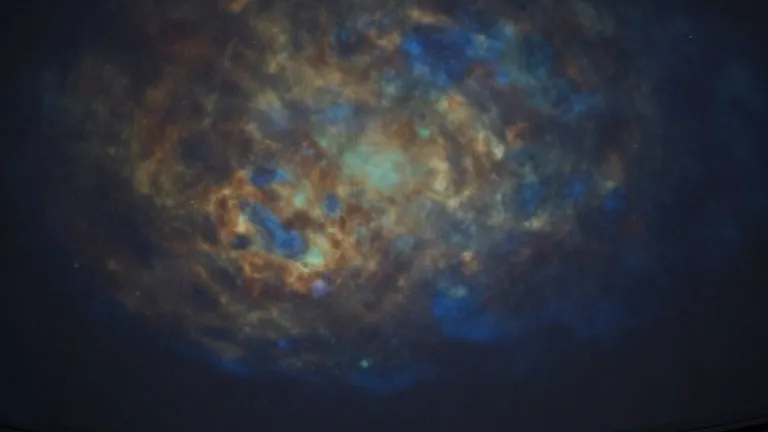
The analysis focused on the cosmic microwave background, the light released from the early universe. For the first 380,000 years after the Big Bang, hot plasma trapped that light. As expansion cooled the universe, atoms formed and light began to travel freely. Gerlach, a theoretical physicist at the Mainz Institute for Theoretical Physics in Germany, described it as "a snapshot of the infant universe covering the whole sky."
Iovino, a theoretical physicist at New York University Abu Dhabi, said the background's temperature "varies from place to place by about one part in 100,000," a pattern reflecting how matter was distributed at that time. The study found the background lacks the graininess that stupendously large black holes would have produced. "So these black holes can't be a significant part of the dark matter," said Nicholas Leister, a theoretical physicist at the Mainz Institute for Theoretical Physics.
The authors stated the result does not mean such enormous black holes cannot exist, only that they do not constitute a major component of dark matter. They noted that relatively tiny black holes about the size of asteroids remain a possible candidate, and said they are now examining whether those too can be ruled out as a major constituent.
More Business · Tech news · Business Complaints · Report a business · Got a Story?