Convoy evacuates civilians from Oleshky after four-year siege
A joint relief effort transported residents out of the Russian-held Ukrainian city, marking the first such operation since the start of the full-scale invasion.
By Malik Salazar ·
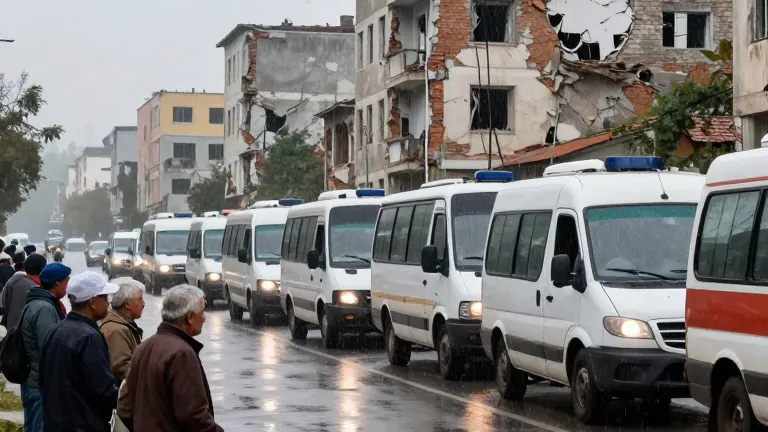
Civilian evacuations began in the Russian-controlled city of Oleshky on Friday, the first coordinated relief operation in the location since the war began in February 2022. The city, situated on the occupied bank of the Dnipro River directly opposite Kherson, has faced severe shortages of food and medical supplies for months.
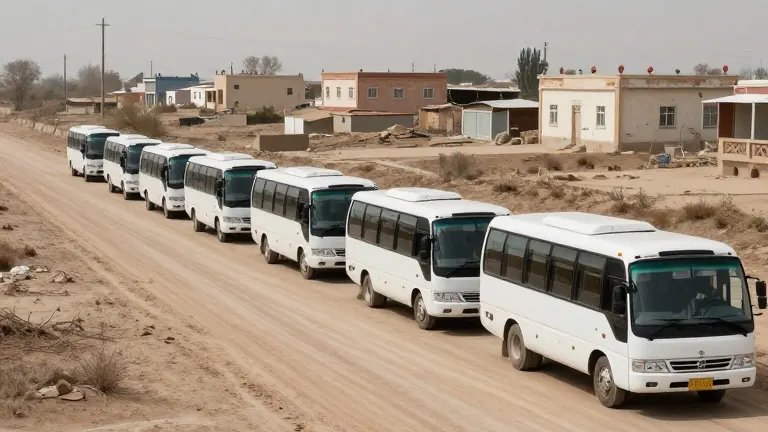
A humanitarian convoy consisting of 25 buses and ambulances entered the city to deliver aid and transport residents to either Russian or Ukrainian territory. The movement was enabled by a localized ceasefire in the Kherson region, which allowed engineers to clear mines from the roads leading out of the city.
Davyd Arakhamia, a lawmaker from the Servant of the People party, confirmed that some evacuees were departing for the Russian city of Anapa. He stated that they would fly from Anapa to Belarus before taking buses to their homes in Ukraine. Kyrylo Budanov, head of the Ukrainian presidential office, posted online that the humanitarian operation was underway, though he was not present at the site.
The route for those heading to Ukraine required a journey to Anapa, a flight to Belarus, and a drive across the border into the Chernihiv region. Although earlier reports indicated that more than 500 people wished to move to Ukrainian territory, the exact number of individuals in the initial convoy was not immediately clear.
Ukrainian delegation members arrived in Oleshky late on Friday morning. Social media footage showed residents gathering in heavy rain, with some visibly emotional as they embraced the arriving officials. Several hundred people, mostly elderly residents, opted to remain in the city.
One resident identified as Anna told a delegation member on video that she was assigned to bus 20, while her son was on bus 17, with both traveling to Ukraine. Authorities and volunteers estimate the city’s population has dropped to approximately 2,000 since the start of the conflict. Many remaining residents have described risking their lives on mine-strewn paths to obtain food and water, sometimes surviving on a single cup of rice or buckwheat daily.
Ksenia Arkhipova, a volunteer who maintains contact with people in Oleshky, told the Associated Press that large numbers of Russian military personnel are stationed in the city. She noted that soldiers are inspecting and occasionally occupying empty houses while pressuring locals to evacuate to Russia rather than Ukraine.
First Lady Melania Trump claimed to have helped broker the ceasefire that facilitated the convoy. The Kremlin described the arrangement on Friday as a special case that was difficult to extrapolate to the wider peace process. Oleshky has suffered extensive damage and flooding since the destruction of the Kakhovka dam in June 2023.
Dmytro Lubinets, Ukraine’s human rights ombudsman, coordinated the operation on the ground with Russian counterpart Yana Lantratova. Lubinets acknowledged that many residents were choosing to stay, stating that it was their own choice. He added that this was the first time since 2022 that a ceasefire had been established across such an extensive stretch of the frontline and maintained for such a duration.