New Model Replicates Mars Cloud Using Rare Ice Formation Process
Researchers at Sorbonne Université say the Arsia Mons cloud forms via homogeneous nucleation, a mechanism never before seen in a planetary atmosphere.
By Sarah Montgomery ·
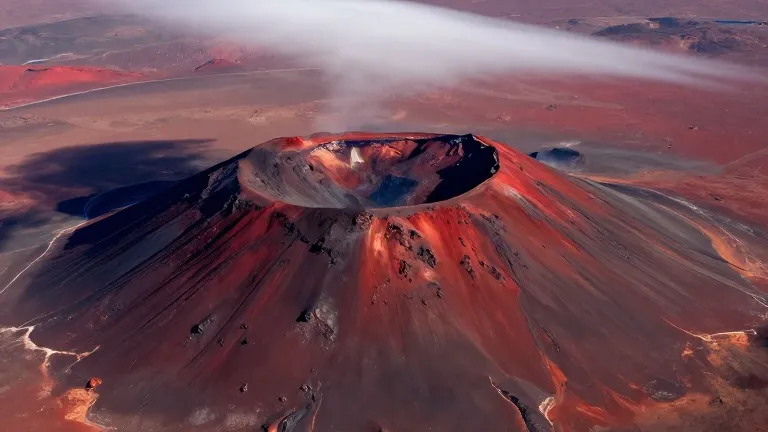
A computer model has successfully reproduced the formation of the Arsia Mons Elongated Cloud, a feature that stretches over 1,000 miles across the Martian sky. The study, published in Nature Geoscience on October 23, 2026, offers the first plausible explanation for how this massive cloud appears and disappears during the Martian spring and summer. The cloud was first detected by a probe in 2018, but scientists struggled to account for its behavior until now.
Lead author Jorge Hernández-Bernal, a planetary scientist at Sorbonne Université in Paris, stated that the simulations only succeeded after the team incorporated what he called 'exotic physics.' This specific process, known as homogeneous nucleation, involves water vapor turning directly into ice crystals without needing dust or salt particles to act as seeds. Hernández-Bernal noted that while this physics appears in textbooks, it is usually considered theoretical and unlikely to occur in nature. 'Once we included this physics in our simulations, the AMEC emerged just as we hoped,' he said.
The formation of the cloud relies on extreme conditions triggered by the volcano Arsia Mons. When wind hits the 65,000-foot peak, it generates a powerful wave that lifts moist air high into the atmosphere within minutes. This rapid movement causes the temperature to drop by 30 degrees Celsius in just 10 minutes. The study indicates that such a sharp cooling effect is necessary to initiate the ice formation.
The process requires humidity levels that far exceed those found on Earth. The model suggests that the relative humidity needed for this nucleation is more than 100,000 times greater than any value measured in the Earth's atmosphere. Scientists had not previously known that such high humidity levels existed on Mars. Hernández-Bernal compared the phenomenon to condensation appearing in the middle of a room rather than on a window, describing the mechanism as 'wholly unexpected.'
The cloud appears gradually longer through the morning hours before dissipating, a cycle that repeats over several months. Its length is comparable to the straight-line distance from New York to Kansas City. Prior to this study, researchers assumed similar nucleation might occur in the upper atmospheres of other planets, including Venus and Earth, but it had never been directly observed. The new findings suggest the Martian atmosphere behaves in ways that were not previously understood.
Hernández-Bernal acknowledged that far less is known about the Martian atmosphere than about Earth's. He described the ability to reproduce the cloud in a model as a 'remarkable' result. The study provides a concrete mechanism for the AMEC, moving the feature from a mystery to a predictable atmospheric event driven by specific thermal and wind dynamics around the volcano.