Journalist breaks finger in Lagos attack ahead of 2027 Nigerian elections
Violence against opposition supporters and press personnel is rising as the country approaches its January 16 vote.
By Harper Laurent ·
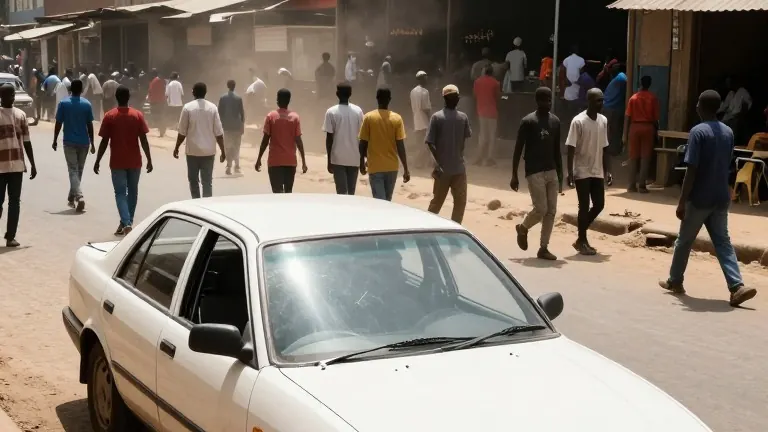
Samuel Adebanjo was photographing attendees at a National Democratic Congress town hall in the Oregun area of Lagos on a routine day when five armed men chased him into a parking lot. They wielded axes, cutlasses, and wooden planks while chasing party supporters. Despite wearing a press jacket, the attackers accused him of being the party's cameraman and tried to seize his equipment. During the struggle, one man swung an axe at Adebanjo's wrist. He raised his hand to block the blow, and the blade struck his wristwatch. He later went to a hospital with a broken middle finger and internal rib injuries.
The incident is one of many as Nigeria prepares for a general election on January 16, 2027. President Bola Tinubu is running for re-election with a platform focused on security and economic recovery. The National Peace Committee has recorded 109 breaches of the National Peace Accord across 26 states and the federal capital since the campaign began. Political violence and thuggery caused 33 of those violations between August 19 and October 27. Misinformation and disinformation accounted for 29 others.
Attacks are not limited to Lagos. On November 15, a convoy for former Kano governor and NDC vice-presidential candidate Rabiu Kwankwaso was targeted in the Bichi area of Kano. Similar incidents occurred in Sokoto and Kebbi when former Vice President Atiku Abubakar campaigned in the northwest. Civil society groups, including Amnesty International, have condemned the violence. They have asked security agencies to hold perpetrators accountable. President Tinubu denounced the attacks and warned that intimidation threatening public order will not be tolerated.
Raheem Mutiu, a researcher at the Armed Conflict Location and Event Data project, noted that political groups appear more determined to win by any means. He said more than 30 politically linked attacks with 10 fatalities have occurred in about two months. He described the violence as more frequent and geographically widespread than in previous cycles. He added that Nigeria's winner-takes-all system fuels fierce competition, and perpetrators often act as anonymous proxies, making them hard to identify.
Dengiyefa Angalapu, a researcher at the Abuja-based Center for Democracy and Development, said a voter choosing under threat is not choosing freely. He warned that fake news and hate speech can deceive voters and undermine trust in genuine information. He noted that intimidation could push people to avoid meetings or leave politics entirely. More than 103 million Nigerians are registered to vote in 2027. In 2023, only 27 percent of nearly 94 million registered voters cast ballots, the lowest figure since 1999.
Adebanjo is still recovering from his injuries. He questioned what the violence means for ordinary citizens who do not have press credentials. "If this could happen to me, a journalist, how much more to the citizens? I am not sure, at this stage, people will even come out to vote," he said.