Three Orionid meteors recorded over Georgia city
Photographer Tim McCollum captured debris from Halley's Comet in Toccoa, Georgia, two days before the shower's expected peak.
By Sarah Montgomery ·
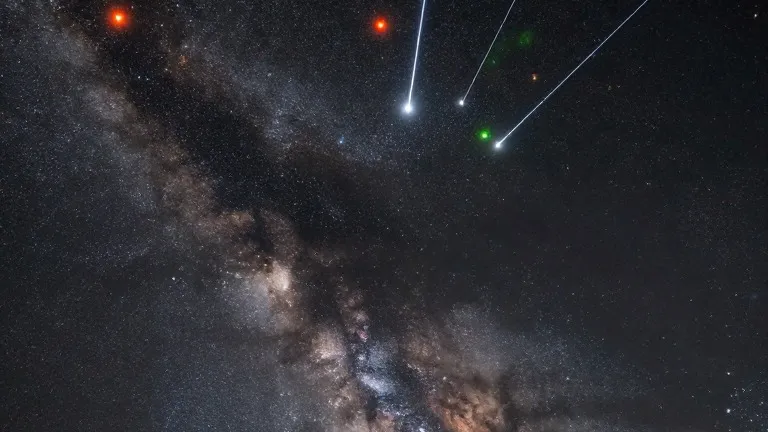
A local photographer captured three distinct meteor trails from the Orionid shower over Toccoa, Georgia, on October 21. The event marks one of the earliest visual confirmations of the annual display before it reaches its highest activity levels.
McCollum photographed the meteors between 3:00 a.m. and 4:00 a.m. local time. Each streak originated near the radiant point, which aligns with the position of Betelgeuse in the constellation Orion. The particles creating these light trails are debris shed by Comet 1P/Halley. Despite the comet itself being more than 3 billion miles from Earth, its leftover material continues to intersect with the planet's atmosphere.
The capture required specific equipment and technical execution. McCollum used a Canon EOS Ra camera paired with an RF 28-70 f2.0 lens. He employed a star tracker to maintain focus on the radiant while taking multiple 30-second exposures. The individual frames were later merged into a single composite image using PixInsight software.
The final image contains additional deep-sky objects beyond the three meteors. The stars of Orion's Belt appear on the right side, adjacent to the Orion Nebula. The Rosette Nebula, designated as Caldwell 49, is also visible within the dense starfield of the Milky Way's galactic plane. Various star clusters are scattered throughout the frame.
The Orionid shower remains active until November 7. Observers in the northern hemisphere still have several nights to spot meteors from this stream. The shower is currently approaching its peak activity, which typically occurs in late October.
Earth is also passing through debris streams from Comet 2P/Encke, the source of the Taurid meteor shower. This overlap can occasionally produce bright fireballs in the sky. Skywatchers who observe such events are encouraged to share their photographs and locations with space media outlets.