NASA Locks In 14-Day Orbital Gauntlet to Vet Moon Lander Hardware
The agency will burn through three different heavy-lift rockets to test two competing landers before the 2028 crewed landing.
By Malik Salazar ·
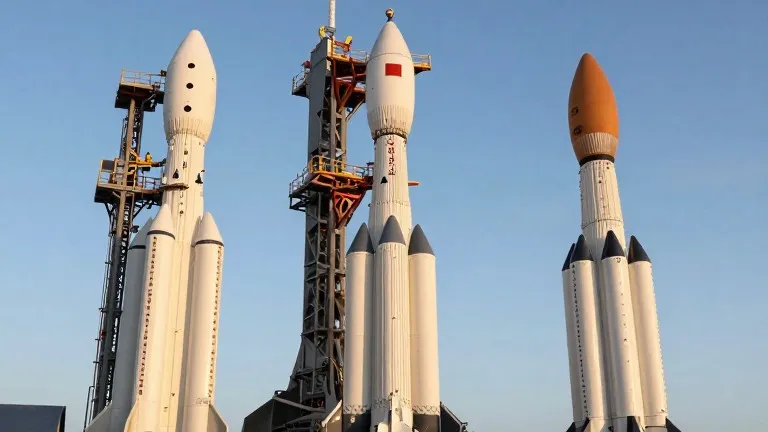
NASA will fly two different commercial moon landers in a single 14-day orbital test to determine which one carries astronauts to the surface in 2028.
The agency detailed the complex mission timeline on Thursday, Oct. 23, during a two-hour press conference at Kennedy Space Center in Florida. The plan serves as a final validation step before the first crewed lunar landing since Apollo 17 in 1972.
The sequence begins with Blue Origin's New Glenn rocket launching the Blue Moon lander into low Earth orbit. NASA's Space Launch System follows, carrying the four-person crew aboard the Orion spacecraft. The roster includes NASA astronauts Randy Bresnik, Andre Douglas, and Frank Rubio, along with European Space Agency astronaut Luca Parmitano.
Orion will initially enter a highly elliptical orbit between 18 and 1,122 miles in altitude before adjusting to a circular orbit at 345 miles. This maneuver addresses thermal stability, as Orion was designed for deep space conditions rather than the harsher heat of low Earth orbit.
The crew spends two days inspecting Orion systems. On Flight Day 3, they dock with Blue Moon at an altitude of 273 miles. The crew enters the lander for two days to test environmental controls, life support, and emergency procedures. Mission Control will also test dual-vehicle control protocols during this phase.
Starship launches on Flight Day 6 with a special docking adapter. It meets Orion on Flight Day 8 at 237 miles. This encounter lasts approximately two hours. The crew does not enter Starship but collects data on docking forces and vehicle interaction. After undocking, Orion continues the mission for another six to nine days before splashing down in the ocean.
The nominal mission duration is 14 days, though it could extend to 17 days. The crew will complete survival suit evaluations missed during the 10-day Artemis II flyby in April, along with health assessments and technology demonstrations. The results will directly inform preparations for Artemis IV, which targets a landing near the moon's south pole in 2028.
NASA has not selected the winner for the 2028 landing. Administrator Jared Isaacman said the agency is keeping both options open to ensure readiness. He noted there is no intention of surrendering a viable path to the surface before data and schedule require it. Parsons added that both providers are planning lunar landing missions for 2028. The launch date for this test remains uncertain, with a target of next summer, though Isaacman recently noted the mission is about 90 days behind schedule.