Square Cuts Off Verified Business With No Explanation
A digital marketing firm provided all required verification documents to Square, yet the platform suspended the account and denied the appeal without stating a reason.
By Harper Laurent ·
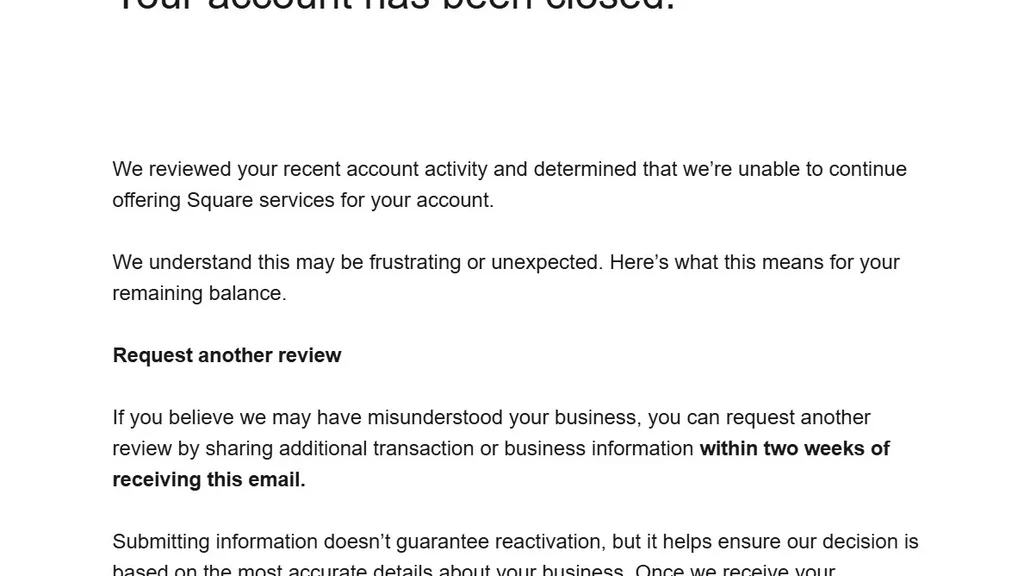
A small digital marketing and SEO firm completed every step of the verification process for its Square account. The business submitted its IRS Employer Identification Number document, linked a valid bank account, and provided its LLC formation papers. It even supplied a signed client contract proving the legitimacy of the funds involved. Despite providing this comprehensive documentation, Square suspended the account. The platform did not cite a missing document, a failed bank check, or a fake tax ID. Instead, it relied on a rule that was not even listed as a valid reason for suspension. The business did not break the rule. The rule itself did not exist in the standard list of grounds for action. However, the automated system had made its decision, and the machine did not accept questions.
The business filed an appeal immediately. Square promised a response within ten days. It took two weeks for a reply to arrive. When it finally did, the result was a denial. There was no explanation attached. There was no stated reason. There was no human representative to call, no physical office to visit, and no face to look at while they explained why the business and its funds were no longer welcome. The outcome was simply a denial generated by an automated process.
You provided your identity. You provided your tax documents. You provided your bank account details. You provided the contract that proved the money was real and the client was real. In return, the business received a suspension with no stated cause and an appeal that ended without clarification. This situation should anger every small business owner in the country because the terms governing this interaction are written in Square’s own contract, in their own words, on their own website.
Square’s General Terms of Service, specifically Section 12, state that they may terminate the terms or suspend the account at any time for any reason. The phrase "for any reason" implies that a reason is optional. Section 13, which addresses the effect of termination, states that Square will not be liable to the merchant or any third party for compensation, reimbursement, or damages for any termination or suspension of the services. This means they can take the account, hold the money, and disrupt the business, and they are not financially liable for the impact.
Their Payment Terms add more layers to this dynamic. Section 12 of that document says they may defer payout or restrict access to proceeds, either temporarily or indefinitely. This allows the merchant’s revenue, including money the client has already paid, to sit in the company’s account while the system decides the fate of the business. Section 14, regarding the reserve for holding funds, states that Square may require a reserve for any reason related to the use of services. The amount of this reserve is determined reasonably by Square itself, not by a bank, a regulator, or a judge.
There is a notable irony in this structure. Square’s Payment Terms, Section 1, open with a clear statement: "We are not a bank." They describe themselves as a payment facilitator and a software platform. They act as the pipe that moves money, not the reservoir that stores it. Yet this pipe holds more power over the business than the bank that actually holds the funds. A traditional bank must follow specific rules and explain its actions. It is subject to regulation. Square is a software company with a suspension button, and that button appears to have no off switch.
When a merchant tries to fight the decision, the contract is waiting. Section 22 of the General Terms prohibits class actions and jury trials, requiring individual arbitration in Oakland, California. Section 19 caps their total liability to the merchant at the fees earned in the three months before the problem occurred, or $500, whichever is greater. That is the maximum value of the business to them, according to their own agreement. Section 7 states that if there is a dispute about ownership of the account, Square will be the sole arbiter of the dispute in its sole discretion. Their decision is final and binding on all parties. They act as the player, the referee, and the stadium.
This is the environment small businesses now operate in. A company that is not a bank acts like one. An automation system scrutinizes a business with zero reason and zero explanation. A merchant who followed every rule is suspended by a criterion that was not even a listed reason for suspension. The appeal process takes twice as long as promised and ends without a word. The business cannot easily dispute the outcome because doing so means arbitrating in Square’s city, under Square’s rules, for a prize capped at five hundred dollars.
Square maintains a list of "Unsupported Industries" in its Payment Terms. Item six on that list includes direct marketing or subscription offers or services. A marketing and SEO firm is one algorithmic decision away from being categorized into that group. The machine does not need the rule to be technically true. It only needs the rule to be convenient.
Where is the bank that has to explain its actions? Where is the regulator that has to show its work? Where is the human being who has to look you in the eye and say why they suspended you? There is no one. There is a dashboard. There is a denial. There is a machine that has never met the business, never read the contract, and never spoken to the client, yet it has already made a decision.
This is not just a payment processor. It is a toll booth on the only road the business has to operate. It is run by a company that is not a bank, governed by a contract that says they can do whatever they want, whenever they want, for any reason, and owe the merchant nothing for it. The verified business did everything right. Square did not need it to.
That is the whole story. That is the whole system. Until a company that is not a bank starts acting like one, every small business in the country is one algorithmic step away from losing its money, its account, and its voice. No reason is given. No explanation is owed. The system relies on the merchant’s compliance while retaining the power to cut the connection at any moment without consequence.
The verified business provided its ID, its IRS EIN, its LLC documents, its bank account, and its client contract. It did everything right. The suspension happened anyway. The appeal was denied two weeks after the deadline. The money is held. The reason is unknown. The liability is capped at five hundred dollars. The venue is Oakland. The arbiter is the company itself.
Small business owners are left to wonder if they are protected by the law or merely by the mood of an algorithm. The terms of service are clear in their language. They grant broad powers to the platform. They limit the rights of the merchant. They remove the need for human interaction. They make the process fast for the company and slow for the user.
The marketing firm is not unique in its experience. It is a case study in the power dynamics of modern digital commerce. The machine does not care about the quality of the work. It does not care about the reputation of the firm. It does not care about the validity of the contract. It only cares about the data points it has collected and the rules it has applied, some of which may not even exist in the written list of grounds for suspension.
The business is left with a denied appeal and a held balance. The client has paid. The work is done. The money is stuck. The explanation is missing. The remedy is limited. The power is unequal. This is the current state of affairs for many who rely on digital payment processors to run their operations. The terms are written in plain English, but the implications are not always clear until the account is suspended.
The firm did everything right. It verified its identity. It linked its bank. It provided its tax ID. It showed its contract. It followed the rules. And still, the machine said no. The denial was final. The reason was absent. The liability was capped. The process was automated. The outcome was a loss of access and a loss of funds. The system worked exactly as designed. The design favors the platform. The merchant is left to navigate the consequences without guidance or recourse.
More Business · Business Complaints · Report a business · Got a Story?